
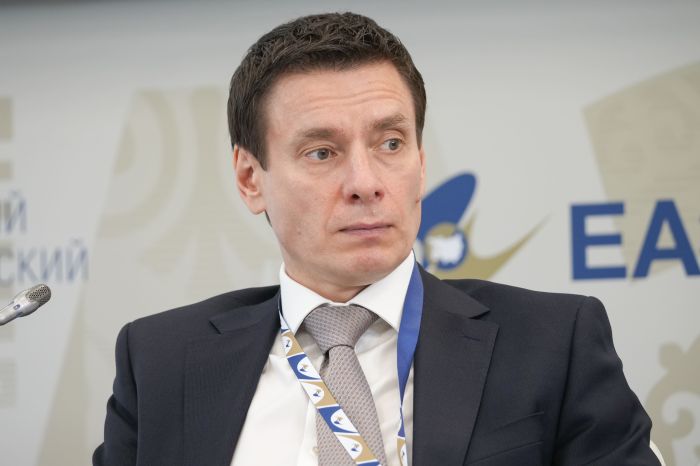
It was stated by the Minister in Charge of Trade of the Eurasian Economic Commission when he opened the session ‘The EAEU’S Climate Agenda: New Trends and Practical Solutions’ at the second Eurasian Economic Forum. Such topics as access to technology and finance, as well as opportunities and risks for business were addressed during the discussion.
“The roadmap adopted by the prime ministers of the Eurasian Economic Union countries for cooperation on the climate agenda is being implemented in these three main areas,” emphasized Andrey Slepnev.
The EEC Minister noted that technological sovereignty and technological transformation are among the main issues facing all EAEU countries. The convergence of states on the climate track will not only help deepen integration processes but will also strengthen the position of the Union and each of its members individually on world markets.
To this end, the EEC launched the Climate Technology and Digital Initiatives Bank in 2022. It aims to foster industrial cooperation within and outside the Union. It currently includes around a hundred projects from major companies. This number will be enriched by the winners of the Green Eurasia International Climate Competition that just concluded.
“Here we can also say that technology transfer and the very policy of technological neutrality are a crucial element for discussions at the global level. Our roadmap stipulates that we work together within the Union and with our partners to promote our common interests in climate agenda on international platforms – above all the UN Framework Convention on Climate Change,” said Mr. Slepnev.
As for access to finance, Andrey Slepnev reminded that the implementation of climate projects in the world requires funding, which would be in the order of tens of trillions of dollars annually. He informed the meeting participants about the recently approved criteria for green projects in the EAEU countries (model taxonomy). The purpose of the document is to stimulate and converge approaches within the framework of systematic development of green financing tools.
“Once the rules for verification of the EAEU model taxonomy have been developed, there are plans to launch green financial instruments for the cooperative Eurasian project in accordance with the Union’s model taxonomy as a pilot project,” added Mr. Slepnev.
Also, according to Mr. Slepnev, during the implementation of the roadmap, the national legislation of the EAEU countries on climate regulation was analyzed, aiming, among other things, to avoid barriers to mutual trade.
“In order to avoid such barriers, the possibility of a common market for carbon units seems preferable. This requires the development and implementation of a common infrastructure regulation and, in addition, the alignment of the tensions in industry decarbonization plans. Without them, a target value of the carbon unit and a real market cannot be achieved,” concluded Mr. Slepnev.
He singled out the efforts in technical regulation, where, inter alia, the Russian Federation has already introduced a draft decision on the sixth environmental class of road transport. One of the issues to be resolved is the year when new cars with traditional internal combustion engines will stop being produced.
The climate session was attended by Ilya Torosov, First Deputy Minister of Economic Development of the Russian Federation; Eric Grigoryan, Authorized Representative of the Republic of Armenia for the Debt-for-Climate Mechanism; Aidar Kazybayev, Chairman of the National ESG Club of the Republic of Kazakhstan; Nazarbek Malaev, Deputy Minister of Economy and Commerce of the Kyrgyz Republic; Ekaterina Salugina-Sorokovaya, First Vice President of Gazprombank; and Alexey Miroshnichenko, First Deputy Chairman of VEB.RF – Member of the Board of VEB.RF. Simon Steele, Executive Secretary, Secretariat of the United Nations Framework Convention on Climate Change, and Selwin Charles Hart, Special Adviser to the Secretary-General on Climate Action, United Nations, addressed the participants via video. The discussion was moderated by Andrey Sharonov, Chief Executive Officer, National ESG-Alliance.
