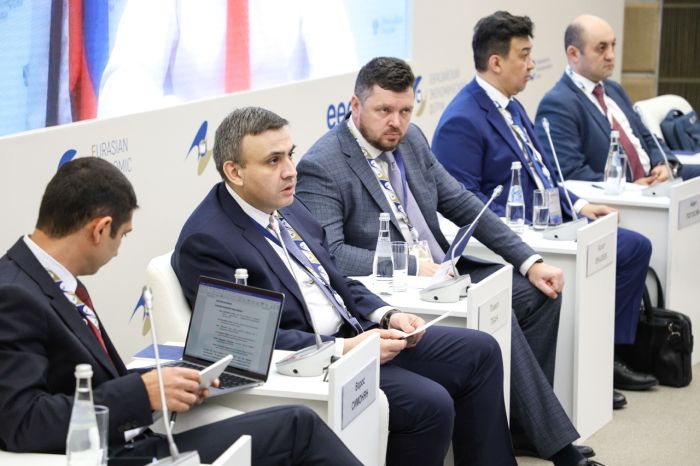
The member states of the Eurasian Economic Union (EAEU) need to synchronize their work and pool their resources to achieve the most effective digital transformation and secure import independence. This was the opinion of experts and representatives of federal government agencies at the session Digital Transformation of the EAEU held at the Eurasian Economic Forum.
KEY CONCLUSIONS
Efficient digital transformation of the EAEU requires the coordinated work of its members
"We must not in any way limit the digital agenda of the Union by implementing digital initiatives. We have already received orders from the Intergovernmental Council and instructions from the heads of government, stating the need for member states to present their new vision on the reformatting of digital agenda mechanisms. Our work in this regard is very closely and effectively done. <...> Digitalization is not only developing rapidly within our countries but also around the world. <...> Instead of isolating ourselves from the outside world or entering into internal competition... we must act as one. <...> We see digitalization... within the Union as more than just ensuring the entire digital framework. It is also a valuable tool for boosting economies and for eliminating barriers that exist within our Union,” said Varos Simonyan, Member of the Board (Minister) for Internal Markets, Informatization, Information and Communication Technologies, Eurasian Economic Commission.
"We are already discussing the issue of interstate services. I am glad that there is now a focus in this direction. We are prepared to provide strong support for this. <...> It is necessary for the legislation of our countries to align with each other in terms of the Eurasian agenda. <...> While Kazakhstan is not willing to transfer even a fraction of its digital sovereignty to any organization, including international ones, it does not mean that we cannot interact... and ensure that our citizens have access to the entire range of services they require on the territories of other EAEU countries,” said Askhat Orazbek, Vice Minister of Digital Development, Innovation and Aerospace Industry of the Republic of Kazakhstan.
"Competition and market freedom should be at the heart of all the documents adopted within the Union. This will significantly benefit the entire high-tech sector, particularly in terms of digitalization," said Avet Poghosyan, Deputy Minister of High Tech Industry of the Republic of Armenia.
PROBLEMS
EAEU states cannot fully ensure import independence in the IT sector if they are isolated from each other
“Except for Russia, which has a large market, it is unlikely that any single country can [achieve import independence – Ed.]. <...> Implementing significant projects within a single country is generally impractical because it requires substantial effort and the effect is small,” said Pavel Tkach, First Deputy Minister of Communications and Informatization of the Republic of Belarus.
"Focusing on import substitution within one's own country is a dead-end development path. <...> History shows that any isolation ultimately results in decline. <...> I think it is crucial to approach import independence and substitution from a broader perspective, taking into account the context of the Eurasian Economic Union," said Askhat Orazbek, Vice Minister of Digital Development, Innovation and Aerospace Industry of the Republic of Kazakhstan.
SOLUTIONS
Making adjustments according to best practices in state regulation of the digital environment and using opportunities for cooperation
"We need to get the emphasis right. This is Union software and hardware. <...> At the Union level, practically anything is possible, given the capabilities present in our countries. These include not only scientific and technical capacities but also production capacities, as well as our existing and evolving relations with third countries. <...> To strengthen digital sovereignty, we need to actively use the scientific and technological foundations that exist in our countries, complementing each other, using all cooperative opportunities," said Varos Simonyan, Member of the Board (Minister) for Internal Markets, Informatization, Information and Communication Technologies, Eurasian Economic Commission.
"The sales market is very important. If we cooperate together, our markets become much bigger, making it easier and more interesting for our companies to operate within these markets. <...> Many more products will appear, including those aligned with the digital agenda," said Andrei Zarenin, Deputy Minister of Digital Development, Communications and Mass Media of the Russian Federation (online).
"If we are referring to import substitution, particularly in terms of digital solutions and hardware like microchips, I think it's really necessary. <...> Individually, each country... within the EAEU will find this problem very difficult to solve. But, if we combine and consolidate our capabilities, and redistribute our functions, I think we will come out of this situation very well," said Indira Sharshenova, Deputy Minister of Digital Development of the Kyrgyz Republic.
"We are ready to build data centres on the territory of the Republic of Kazakhstan that your companies can use. Kazakhstan is not under sanctions. We can buy the necessary equipment, servers ... provide services for your companies. The only thing we need is a good communication channel," said Askhat Orazbek, Vice Minister of Digital Development, Innovation and Aerospace Industry of the Republic of Kazakhstan.
For more information, visit the Roscongress Foundation’s Information and Analytical System at roscongress.org/en
